
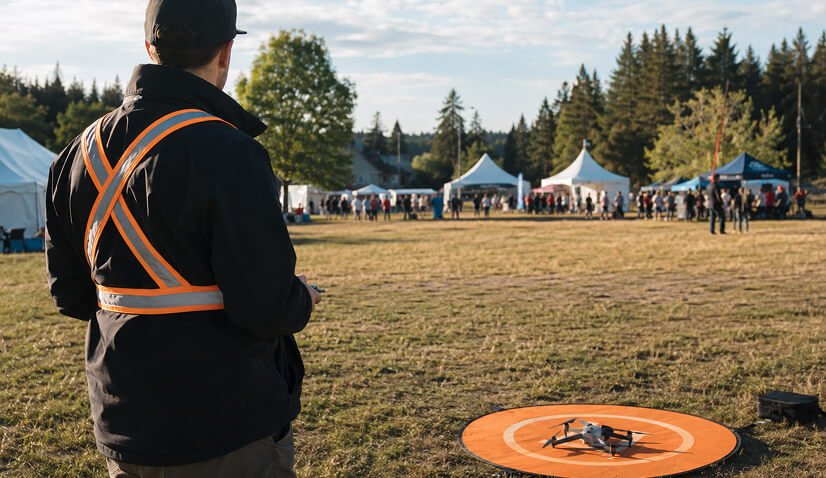
Most drone violations I see are not reckless flying. They're paperwork mistakes made at speed. Someone thinks they are operating under one set of rules, but the flight they're about to do actually belongs to a different category.
If you're a capable pilot, that mismatch is frustrating because it feels unnecessary. The good news is that this is fixable, quickly, if you have a simple way to sort every job into the correct bucket.
This post is that bucket system. It is not meant to be a full course. It is meant to help you answer one question with confidence before you accept a job or launch the aircraft:
What rules apply to me on this flight?
Step 1: Start with the operation category, not the drone
Transport Canada is very clear that you need to understand your category of operation to know which pilot certificate you need and which rules apply. Your privileges depend on what you are doing and where you are doing it, not just on what you own.
In 2026, think in four buckets:
- Basic operations
- Advanced operations
- Level 1 Complex operations
- Special operations (the ones that need specific permission such as an SFOC)
Transport Canada's own "Getting a drone pilot certificate" page summarizes that there are three pilot certificates: Basic, Advanced, and Level 1 Complex. Your certificate needs to match the operation you intend to conduct.
Step 2: The Basic bucket (the most common "safe zone")
Basic operations are the classic starting point. They are still real aviation and still require discipline, but the boundaries are simpler.
Transport Canada defines basic operations with clear conditions including these examples: you fly VLOS, in uncontrolled airspace, with an operating weight not more than 25 kg, and more than 30 metres horizontally from any person. Transport Canada also lists distance requirements from airports and heliports for basic operations.
If your job fits comfortably inside those conditions, you are likely in the Basic bucket.
What commonly pushes people out of Basic is not the drone. It is proximity. Proximity to bystanders. Proximity to controlled airspace. Proximity to the places where aviation traffic is more active.
Step 3: The Advanced bucket (more access, more responsibility)
Advanced operations exist because real work often happens closer to controlled airspace and closer to people, in places where the margin for error is smaller. You can't treat Advanced like a "better Basic." It is a different operating environment.
Transport Canada places Advanced in the same overall operation category framework and ties it to the Advanced pilot certificate requirements. NAV CANADA also reflects these categories in NAV Drone planning, where Advanced operations require an Advanced or Level 1 Complex pilot certificate.
The practical takeaway is this: if your missions routinely involve controlled airspace planning, coordination, or tighter operating areas, you need to be operating like a professional system, not a solo hobbyist.
That system is what protects you when conditions change on site.
Step 4: Level 1 Complex (the 2026 "new normal" for certain missions)
This is where many experienced Advanced pilots will feel the ground shift in 2026.
Transport Canada's expanded regulations introduced a new certification process for lower risk BVLOS called Level 1 Complex Operations.
Transport Canada also states that pilots who hold a Level 1 Complex certificate can conduct basic and advanced operations, but that complex operations also require flying under an RPAS Operator Certificate (RPOC).
Here is what that means in plain language.
Advanced is not obsolete. Advanced is still a strong professional level. But Advanced does not automatically cover the kinds of missions that now sit inside the Level 1 Complex framework, particularly anything that moves into the "complex operations" environment and the operational structure that comes with it.
Transport Canada's summary of changes describes Level 1 Complex as a defined process and lists requirements such as minimum age, passing exams, completing at least 20 hours of ground school, and passing a flight review.
Transport Canada also publishes a dedicated knowledge requirements document for Level 1 Complex (TP 15530), which is intended to guide ground training and examinations.
Knowledge requirements — Level 1 Complex Operations (TP 15530)If you are trying to plan your next year of training, this is the pathway that opens doors.
Step 5: The category people forget — special operations and the "advertised event" trap
There is one scenario that catches good pilots off guard because it feels like a normal photo or video job: advertised events.
Transport Canada states that you must apply for an SFOC if you want to fly at an advertised event, and that this requirement applies to all drones, including microdrones.
If you do commercial work, you will eventually get a request that sounds harmless, like filming a market, a school event, a local sports tournament, or a ticketed concert. The organizer may tell you they approve. They may even show you a "permission letter."
Organizer permission is not the same thing as regulatory authorization.
In the rule map, advertised events belong in the "special operations" lane until proven otherwise. That one habit will save you a lot of stress.
Step 6: What changed in 2025 that matters in 2026
If you felt like Canada changed the drone rules "overnight," you're not imagining it.
Transport Canada rolled changes in two phases in 2025, with expanded regulations coming into force by November 4, 2025.
The summary page highlights several changes that affect what operators will plan and sell in 2026, including:
- a new Level 1 Complex pathway for lower risk BVLOS
- expanded privileges for advanced pilots in certain operation types
- new rules for medium drones (over 25 kg up to 150 kg) within VLOS
- new technical standards and the concept of RPAS Safety Assurance for certain operations
- new requirements related to microdrones at advertised events
You don't need to memorize that list. You need to recognize what it changes operationally.
It raises the bar on professional planning, documentation, and systems thinking. In aviation terms, it pushes more drone work into a structure that looks and feels like real operations, not one-off flights.
Step 7: The simplest "What applies to me?" checklist
Before you fly, answer these five questions:
- Am I flying VLOS the whole time?
- Am I in uncontrolled or controlled airspace?
- How close will I be to non-participants (bystanders)?
- Is this tied to an advertised or scheduled public event?
- Does this mission require complex operations structure such as operating under an RPOC?
If you can answer those clearly, the correct bucket becomes obvious. If you can't answer them clearly, the problem is not your piloting. The problem is your planning package.
That is fixable.
A note on staying current in 2026
One line I want every professional pilot to internalize is the one Transport Canada repeats across certificates: your pilot certificate does not expire, but you must keep your skills up to date.
Transport Canada has even published a 2026–2027 self-paced study program that pilots can use to satisfy 24-month recurrent training requirements under CARs provisions. It is available free of charge.
4DUAV Stan StoreThat is the direction the industry is moving. Not just licensing, but documented ongoing competency.
Where 4DUAV fits
If you read this and thought, "I can fly safely, but I want a cleaner system so I never guess again," that is exactly the gap we close at 4DUAV.
We teach pilots how to think like operators.
That means a clear rule map, a repeatable airspace and job planning workflow, and structured training pathways for Basic, Advanced, and Level 1 Complex. It also means regulatory assistance when the mission sits in special operations, including SFOC support and the documentation that makes your operation understandable.
If you want the one-page version of the map from this post, download the "What Applies to Me?" Rule Map. If you want to build the full system, book a consult or join our Level 1 Complex ground school.
4DUAV Stan Store