
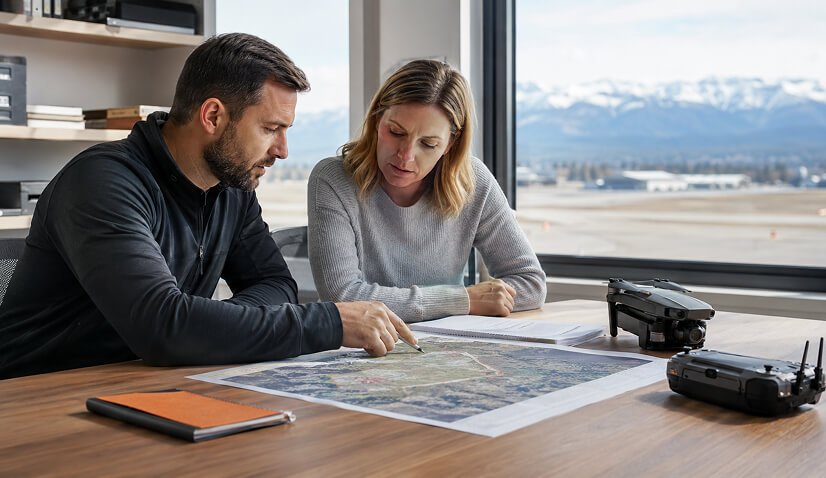
Transport Canada reviewers don't reject you because your mission is ambitious. They reject you because they can't clearly see what you will do, where you will do it, and how you will keep it safe.
That is what a CONOPS fixes.
If you have ever felt stuck in a loop of follow-up questions after submitting an SFOC package, the issue usually isn't the operation. It's the story of the operation. The reviewer is trying to build a mental picture, and the application doesn't give them enough sharp edges to hold onto.
This post will give you a simple, repeatable way to write a CONOPS that reads like aviation: numeric, bounded, and built around decision triggers.
What a CONOPS is, in plain language
CONOPS stands for Concept of Operations. It is the operational narrative that tells Transport Canada what you want to do and how you will do it safely.
Transport Canada's own RPAS Operational Risk Assessment material explains that CONOPS is the first step because it is on the applicant to provide enough information for reviewers to understand the intent of the operation.
RPAS Operational Risk Assessment — Advisory Circular 903-001Think of your CONOPS as the flight plan, crew brief, and safety plan rolled into one document that a third party can read and immediately understand.
What reviewers are really looking for
Reviewers want clarity in four areas.
First, boundaries. They need to know the exact box you will operate inside.
Second, separation. They need to know how you will prevent unplanned proximity to people, property, and other airspace users.
Third, control. They need to know who is responsible for what and how decisions are made in real time.
Fourth, credibility. They need to see that your operation is supported by procedures, records, and a risk process that matches the complexity.
Transport Canada's guidance around special operations makes it clear that an SFOC is for flights that go beyond basic and advanced rules under special conditions. A CONOPS is how you show those conditions are managed.
If you want a useful mental model, write it so a reviewer can answer this question without guessing: "If something changes on site, does this operator have a predictable plan, or will they improvise?"
The biggest CONOPS mistake: writing like a brochure
A CONOPS is not marketing. It is not a narrative about your company. It is not a technical manual.
A strong CONOPS is operational. It is written so that another pilot could follow it.
When I mentor operators, I ask for one standard: if I dropped you into the job site with this document and nothing else, could you run the operation safely?
If the answer is yes, reviewers usually stop asking basic questions.
The 8 sections that reduce back-and-forth
You can write most workable CONOPS documents using eight sections. The goal is not length. The goal is completeness.
1) Operation summary
State what you are doing, where, and why. Include purpose, dates, local time window, and the deliverable. Be specific about what success looks like.
This is also where you state whether the mission is recurring or one-off. Transport Canada notes that for some SFOCs they prefer issuing for a year, and that if a site survey is part of the application you should use an area that represents your concept of operations and explain your process for determining if an area is safe. That language points directly to how they expect you to think about repeatability.
2) Aircraft and configuration
List the aircraft and the configuration that matters operationally. Include make, model, weight class, and any mission equipment relevant to safety and performance. If you are operating above 25 kg or in higher complexity, the level of technical evidence expected often increases, so your configuration control must be crisp.
Advisory Circular AC 903-001A reviewer does not need your full spec sheet, but they do need to understand what the aircraft is capable of and what safeguards exist.
3) Operating area and boundaries
This is where vagueness kills applications.
Define your operating area in a way that can be reproduced: coordinates, a map, or a clearly bounded zone tied to landmarks. Identify takeoff and landing locations, emergency landing areas, and no-fly lines.
If you cannot draw your operation on a map in 60 seconds, your CONOPS is not ready yet.
4) Airspace and aviation traffic management
State the airspace classification, nearby aerodromes or heliports that matter, and how you will avoid conflicts. If the operation involves coordination or authorizations, mention who, when, and how you will communicate.
This is also a good place to show professional discipline: how you document your airspace checks, how you brief the crew, and what triggers a pause or termination.
5) People and property protection
Explain who might be in the area, how you keep them out of your operational zone, and what happens if they enter.
Do not say "we will maintain safe distances." Say what distance, how you will maintain it, and who is responsible for enforcing it.
If you are dealing with an event environment, this section must read like crowd management, even if your drone is small. Transport Canada is explicit that certain environments like advertised events require special permission regardless of drone size, which is a good reminder that environment drives risk.
6) Flight profile and performance limits
Include the planned max altitude, max range, planned path type, number of sorties, and expected duration.
State weather minimums that match the mission. Include personal minimums if they are more conservative than legal minimums. Reviewers like to see that you have thought about what conditions make the mission unsafe.
This section should feel like a pilot's plan, not a general description.
7) Decision triggers, contingencies, and emergencies
This is where aviation-style thinking shows.
List the triggers that cause a pause, an abort, a return, or a termination. Examples include: loss of reliable command and control indications, unexpected aircraft traffic, people breaching the boundary, or gusts exceeding a defined threshold.
Transport Canada's operational risk assessment guidance emphasizes that the CONOPS feeds the risk process and that you may need to adjust the operation to make it safe. That is exactly what triggers allow you to do in real time.
Also state lost link behaviour and your pilot actions. This is often one of the first follow-up questions when it is missing.
8) Attachments and evidence
A clean CONOPS references attachments rather than burying everything in the text. At minimum, consider these attachments:
- A site map with boundaries, takeoff and landing points, and emergency landing areas
- Airspace evidence records for the planning step
- Crew brief card and communication plan
- Maintenance and battery records relevant to the mission readiness
- A short hazard and mitigation table that matches your operation
Transport Canada's SFOC application guidance material exists specifically to standardize what is expected in complex applications, and it reinforces that CONOPS and supporting material are core components.
Advisory Circular AC 903-002A quick quality test before you submit
Before you send your package, hand the CONOPS to someone who knows drone operations but does not know your job. Ask them to answer three questions after one read:
- Where exactly are you flying?
- What will you do if something changes?
- How are people and other aircraft protected?
If they hesitate, that hesitation will show up as reviewer follow-up emails.
The goal: be understood quickly
You do not need a perfect document. You need a document that is clear, bounded, and operationally mature.
When your CONOPS reads like a pilot's plan, you typically get fewer questions, faster decisions, and fewer surprises on site because you have already done the thinking.
Next step: download the CONOPS template or get a professional review
If you want to skip the blank page problem, download the "SFOC Fast Clarity CONOPS Template" from our 4DUAV Stan Store.
If you already have a draft and want it tightened to "reviewer clarity" standard, book a 4DUAV SFOC review. We focus on the exact issues that create delays: vague boundaries, missing triggers, weak attachments, and unclear control of people and airspace.
4DUAV Stan Store