
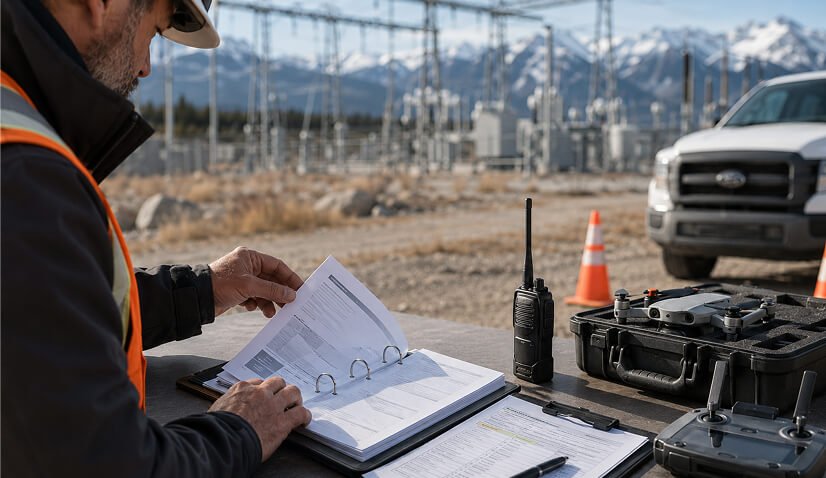
If your manual can't run a job site, it's not a manual. It's paperwork.
I say that with respect for the people who are trying to do things properly. Most operators aren't lazy. They're busy. They're building a business, flying missions, managing clients, and trying to keep up with changing requirements. The mistake happens when the manual becomes a document you write for "the application," rather than a system your team uses to keep operations safe and repeatable.
Transport Canada's direction on RPOC is clear. If you want to conduct Level 1 Complex Operations, you need an RPAS Operator Certificate, and that comes with expectations for training, SOPs, and managing safety risk.
This post is a practical guide to the minimum viable manual set that will actually work in the field.
What Transport Canada expects, in plain language
Transport Canada's manual-development guidance is not hidden. Advisory Circular 901-002 exists specifically to guide RPAS operators in establishing and maintaining an Operations Manual, a Maintenance Control Manual, and the processes that support an RPOC application and complex SFOC applications.
Advisory Circular AC 901-002That's your north star: manuals plus processes. Not one giant PDF. Not a binder that nobody touches. A usable operational system.
The minimum viable manual set
At the simplest level, you need three layers:
- An Operations Manual that defines how you plan and conduct missions
- A Maintenance Control Manual that defines how you keep aircraft airworthy and recorded
- A set of processes that make the manuals real in day-to-day work
This is exactly how professional aviation organizations stay consistent. The drone sector is moving in that same direction.
1) Operations Manual: the job site playbook
Your Operations Manual should answer one question: "How do we run a mission, safely, every time?"
Operational roles and accountability
Who is the accountable executive, who runs operations, and who is responsible for maintenance oversight. Transport Canada's RPOC page calls out that you must appoint an accountable executive and identify the person responsible for maintenance before applying.
Operational planning workflow
A repeatable planning process that starts the same way every time, even if the mission changes. This includes site survey, airspace check, boundaries, crew brief, and a go/no-go decision process.
Standard operating procedures
Normal procedures written for real work, not for theory. Transport Canada's RPOC prerequisites include implementing standard operating procedures during flight.
Abnormal and emergency procedures
Lost link, flyaway, people breach, unexpected aircraft, weather changes. This is where professionalism shows up.
Crew Resource Management (CRM) basics
How the pilot and VO communicate, who can call a pause or abort, and how those triggers are trained. Even simple callouts prevent most chaos.
2) Maintenance Control Manual: airworthiness without drama
Many operators underestimate this manual until something fails on site. The MCM is not about being perfect. It's about being consistent and recorded.
Inspection rhythm
Pre-flight, post-flight, periodic checks, and what "unserviceable" looks like.
Defect reporting and rectification
A simple log that shows when an issue was found, what was done, and when the aircraft returned to service.
Battery control
Charging practices, storage, lifecycle tracking, and handling in cold weather. For many small RPAS, battery discipline is the difference between predictable performance and surprises.
Firmware and configuration control
How you manage updates and confirm aircraft performance post-change.
Who is responsible
The regulations also speak to having a person responsible for RPAS maintenance with duties to plan and oversee maintenance.
Canadian Aviation Regulations SOR-96-4333) Processes: the part most people forget
This is the piece that separates "documents" from "operations." Transport Canada explicitly ties an RPOC to implementing a training program and a process to manage safety risks.
Your processes don't need to be complex. They need to be used. Here is the minimum set that makes an operator system function:
Document control
Versioning, review dates, how updates are approved, and how crews know they're using the current version. If the wrong SOP is in the truck, your manual doesn't exist.
Training and competency records
Who is authorized to do what, what training they've completed, recurrency, and how you remediate gaps. This is especially important as Level 1 Complex grows and teams expand. Transport Canada's 2025 changes introduced Level 1 Complex as a new certification process for lower-risk BVLOS, which raises expectations for structured training and oversight.
Job package process
A standard package for every mission: airspace evidence, site survey notes, boundaries, brief and debrief, maintenance status, and any special permissions.
Safety risk process (SMS-lite)
Transport Canada's RPOC prerequisites include implementing a process to manage safety risks. In practical terms, this means hazard identification, mitigations, reporting, and corrective actions. Keep it simple, but keep it real.
Build modular add-ons, not a monster manual
A common trap is trying to write one manual that covers everything you might do someday. It becomes bloated and unusable.
Instead, build a clean core manual set, then add explainable modules as appendices for specific mission types. Transport Canada's special operations pages explicitly separate operation types such as sheltered operations, EVLOS, and BVLOS contexts in how complexity is considered.
Special drone operations — Transport CanadaModular add-ons that work well in practice:
- EVLOS module (VO positioning, comms, triggers, records)
- Sheltered operations module (site constraints, containment logic, abort criteria)
- Advertised event module (crowd control coordination, sterile area design, comms with security, SFOC package checklist)
- SFOC module (CONOPS template, map standards, attachment checklist)
This structure keeps your core manual lean while still supporting complex work.
A simple "manual usefulness" test
Before you call your manual "done," ask a pilot on your team to plan a mission using only your manual system.
If they need to call you for basic operational steps, the manual is not yet operational. If they can plan, brief, execute, and close out a mission with clean records, you're on the right track.
That is the standard Transport Canada is moving toward: repeatability backed by process.
Next step: start with the RPOC Starter Kit and build from there
If you want a clean starting point, grab the RPOC Starter Kit and use it to build your minimum viable Ops Manual, MCM, and core processes. Then expand with modular add-ons as your operation grows.
If you want this done with you, correctly, and in a way your team will actually use, book a manual build consult or manual review through 4DUAV.
4DUAV Stan Store