
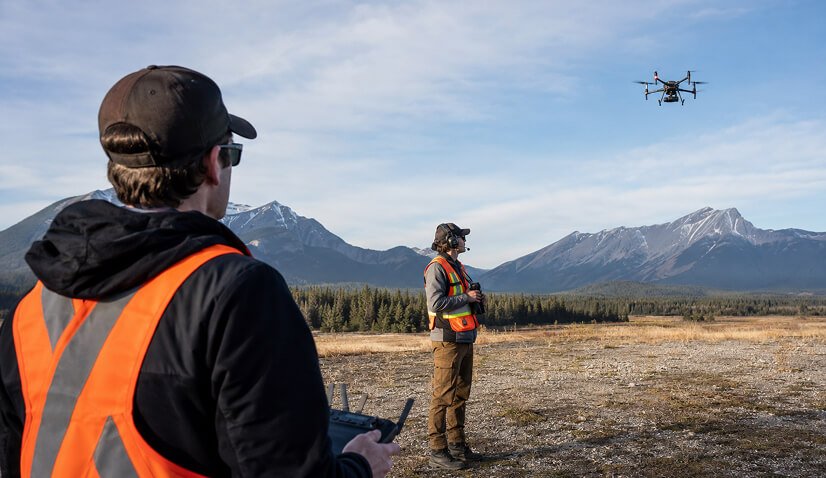
If you want to be taken seriously in Canadian RPAS work, especially around controlled airspace, industrial sites, helipads, or any operation where other aircraft may be nearby, your communications discipline matters as much as your flight skills.
Not because you need to talk on the radio all day, but because professional operators build a system that prevents surprises. Good comms is one of the simplest ways to reduce risk, protect your operation, and earn trust with clients who understand aviation.
This post breaks down three things:
- what "restricted radio licensing" means in Canada
- how monitoring and two-way comms fit into professional operations
- why CRM, SOPs, and SMS-style processes separate teams from solo operators
1) What "restricted radio licence" actually means in Canada
In Canada, the certificate most people are referring to is the Restricted Operator Certificate – Aeronautical (ROC-A).
Innovation, Science and Economic Development Canada (ISED) states that the ROC-A is required for operators of radiotelephone equipment on board aircraft and at aeronautical land (fixed and mobile) radio stations using aeronautical frequencies, and that it is obtained by passing an exam with an accredited examiner.
Here is the professional takeaway:
- If you intend to transmit on aeronautical VHF (airband) frequencies, you need the appropriate certification and you must use proper procedures.
- Having the certificate is not a flex. It's proof you can operate on safety-of-life frequencies without creating confusion or interference.
Canada's Radiocommunication Regulations also set expectations for operating radio apparatus in the aeronautical service in accordance with technical requirements issued by the Minister.
Radiocommunication Regulations SOR-96-4842) Monitoring airband: good practice, not a substitute for authorization
Monitoring relevant frequencies is often good risk management, especially when your operation is near:
- active aerodromes or heliports
- floatplane bases
- common low-level corridors (valleys, shorelines, river routes)
- industrial sites with frequent helicopter traffic
Transport Canada's RPAS knowledge requirements material for basic and advanced operations includes radiotelephony-related knowledge items such as determining frequencies in use and using appropriate phraseology, which signals that radio awareness is part of professional competency.
Knowledge requirements — Basic and Advanced Operations (TP 15263)One important boundary:
- Monitoring does not give you permission to enter controlled airspace or conduct a restricted operation.
- Monitoring also does not replace proper coordination methods and authorizations.
3) Controlled airspace often requires two-way communication capability
If you are operating in airspace controlled by NAV CANADA, being able to communicate effectively is part of operating responsibly.
NAV CANADA's NAV Drone FAQ states that to access controlled airspace, drone pilots need an Advanced pilot certificate and a means to have two-way communication with the appropriate air traffic services unit.
That "two-way comms" does not automatically mean transmitting on airband from a handheld. In many cases, coordination is handled through NAV Drone workflows and other approved communication paths. The professional standard is simple: know what method is expected for the airspace you're requesting and be ready to communicate clearly and promptly.
4) The real professionalism shift: team-based operations and CRM
A lot of drone operators work solo. That can be legal and safe in the right environment. But the moment your work increases in complexity, the solo mindset becomes a limiting factor.
In aviation, CRM exists because humans miss things under workload. Drone teams are no different. Team-based operations reduce risk when:
- the pilot's workload is high (navigation, payload, obstacle environment)
- the operating area has public movement or vehicles
- the airspace is dynamic (helicopters, floatplanes, training traffic)
- the mission requires tight triggers and disciplined decision-making
CRM does not have to be complicated to be effective. The minimum viable CRM for RPAS is:
- clear roles (pilot, VO, payload or spotter if applicable)
- standardized callouts
- agreed decision triggers (pause, abort, return)
- a short debrief loop after each mission
5) SOPs: the difference between "I can do it" and "we can repeat it"
Clients in enterprise, mining, oil and gas, utilities, and public-sector work care about one thing more than your drone model: consistency.
A usable SOP should let a qualified team run a job site the same way every time:
- planning workflow (airspace, hazards, boundaries, permissions)
- comms plan (who talks to who, how, and when)
- emergency triggers (lost link, people breach, unexpected aircraft)
- documentation and records (what gets saved, where it lives)
If your SOP can't run a job site, it's not an SOP. It's a document.
6) SMS thinking: you don't need a "big airline system," you need a real one
A Safety Management System does not have to be heavy to be effective. But it has to be real. A lightweight, operator-grade SMS includes:
- a hazard reporting habit (even for small issues)
- a way to record corrective actions
- a simple trend check (monthly or quarterly)
- training refresh tied to actual issues you're seeing
This is how professional operators become safer over time instead of simply "more experienced."
7) The bottom line: radios, comms, and systems are professional multipliers
Restricted radio licensing like ROC-A is valuable because it supports professionalism and safety when aeronautical radio use is appropriate and authorized.
Restricted Operator Certificate – Aeronautical (ROC-A) — ISEDBut the bigger picture is this:
- Comms discipline prevents surprises.
- CRM reduces workload errors.
- SOPs create repeatability.
- SMS habits create continuous improvement.
That's what enterprise clients are actually buying when they hire "experienced operators."
Next step
If you want to level up from "capable pilot" to "trusted operator," start with systems:
- a clear comms and CRM structure for team ops
- SOPs that your crew can actually follow
- an SMS-lite workflow that makes your operation stronger over time
- and, where appropriate, guidance on ROC-A readiness and professional radio procedures
ROC-A training and certification, downloads, SOP packages, and consult options are all available through our Stan Store.
4DUAV Stan Store